time sped up — a minute passes every second
Alume is the name I gave to an idea I’ve carried for more than a decade: a display without light.
Nearly everything we read today is illuminated. LEDs got small, screens got dense, and the whole digital world settled on one answer: if you want to show something, glow. Alume asks the opposite question: can a display be tactile? A segment pushed forward is on. A segment recessed is off. There is no light. You read it from depth and shadow. The concept is almost nothing at all, and it has never let go of me.
The clock above is the current version, a digital twin in three.js. Each segment glides out and settles the way the real one should, pushed by its own mechanism behind the face.
Edvard Munch
In Oslo I learned about Edvard Munch properly, standing in front of the work. He painted The Sick Child six times over forty years, along with etchings and lithographs of the same scene. He wasn’t fixing mistakes. The motif was the work, and each version was another pass at it; every medium showed him something the last one couldn’t.
I recognized what I was looking at. I’ve been doing the same thing with this clock: one motif, segments that move instead of glow, recreated in whatever medium I could manage at the time.
I’ve built it twice. In 2013 it was paper: papercraft segments over an Arduino. In 2021 it was printed plastic: thirty hobby servos pushing and pulling, each one calibrated by hand because motors never quite match the CAD.
Both times I finished, and both times I was upset at what I’d made. Not impressed at all. I published them anyway. The technology was never the impressive part; none of it is hard to build. What keeps me here is that this is where the art meets the craft meets the technology, and you don’t get to the version in your head without passing through the versions in your hands.
Next steps
If you asked me what’s next, I could tell you exactly what the next iteration looks like. I’ve had four years to think about it.
The gap between the clock in my head and the clock on my desk isn’t insight, or money, or skill. It’s hours — locked-in hours, and duration is exactly what a career takes from you first. I could spend a year on this clock; I can’t spend it and also do my software job. Life will always take you away from your heart.
I don’t really know what the final one looks like, but here’s the version I keep painting in my head: the face cut from a single sheet of Corian, one seamless plane, every segment flush until the moment it slides. Solid all the way through, warm under the hand — no seam, no glow, and no sound, each segment pushed by its own silent stepper motor. Not a clock you set on a desk but something you fix to a wall and leave there: a permanent installation. To machine it that way you need a CNC, and so, slowly, the clock has become a project about the CNC — the space to run one, the time to learn it, the mess it makes in a Singapore apartment. None of that is really the obstacle; it’s time, and time is what I’ve been learning to wait for. So this iteration waits, and I’ve made my peace with the waiting.
But the mechanism behind the face doesn’t have to wait for any of that. Hidden doesn’t mean crude, either — we can already drive silent stepper motors. The current pass has two halves: the web clock above, and a CAD build where each segment rides its own rack-and-pinion cartridge, seven cartridges locking into a wall to make one digit. A solid prototype. If I have spirit and cycles, it will be done.
And this is the strange reward of taking pause: the world comes to meet you where you are. Others are building the same motif, like this kinetic clock by Lukas Deem — Lukas built his straight from my Instructable — and each build answers the mechanism differently: some of the most efficient run a whole display off a single motor, and some drive their segments with fluid gates. None of it makes me feel late. It stays art, and it inspires you again.
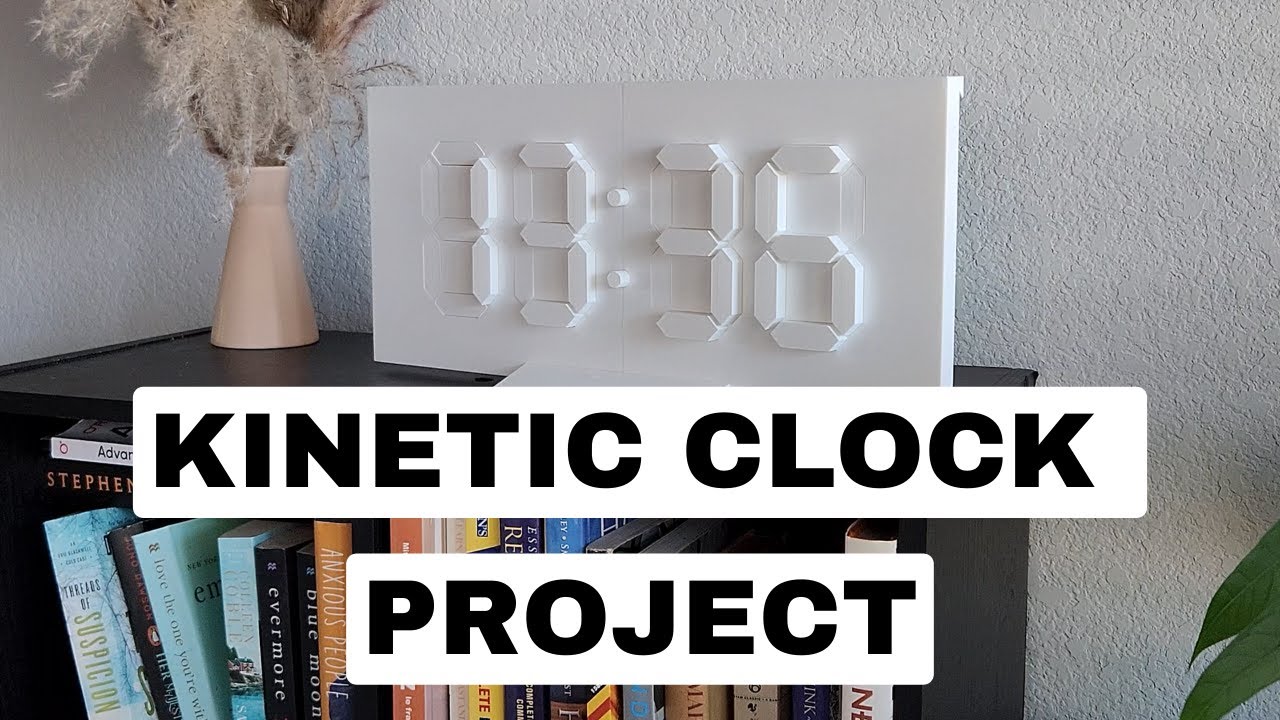
Mine has a different bar. The display just has to move each segment silently and smoothly, in clean orchestration — which trades mechanical economy for more complex motor signalling. So the next stage is modular: it’s mechanical, it needs software, it needs craft, a few pieces of PCB to redesign and send to print. All of it sits at arm’s reach — everything except the time to deliver. That gap is next in line to fill, hopefully soon enough that I can share the next iterations before jumping to the fluid version.
What excites me is the progression — not any single clock, but the journey toward the one that finally settles it. I want to share every iteration, other people’s versions included. This interest was here before my career was, and the obsession comes and goes; that’s fine. I can’t wait to see what this looks like ten years from now. I’m fairly sure I’ll impress myself.